
Why to Choose Commercial Grade Grill for Home Use?
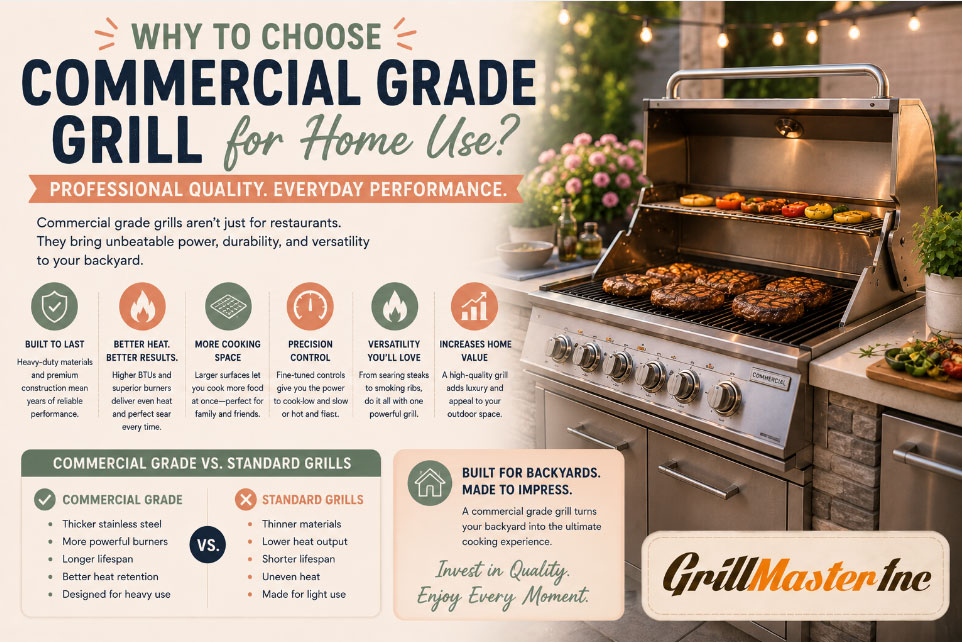
Backyard grilling used to mean a rusting propane box from the hardware store, two burners that never heated evenly, and a grate that warped by the second summer. That era is quietly ending. Walk through any new outdoor kitchen build in the last few years and you'll find the same equipment showing up again and again: heavy-gauge stainless steel, restaurant-style burners, and price tags that would have seemed absurd for a "backyard toy" a decade ago. Home cooks aren't buying bigger grills. They're buying commercial-grade ones.
The question worth asking isn't whether commercial-grade grills are nice to have — of course they are. The real question is whether the upgrade is worth it for a household that grills on weekends rather than during a dinner rush. This piece breaks down what "commercial grade" actually means once you get past the marketing language, why serious home cooks are making the switch, what it costs in real terms over the life of the grill, and which safety and installation details matter before you sign a receipt.
What "Commercial Grade" Actually Means on a Spec Sheet
"Commercial grade" is one of the most overused phrases in outdoor cooking marketing. Plenty of grills wear the label without earning it. To know whether a grill genuinely qualifies, you need to look past the branding and check three things: the metal, the burners, and the warranty.
The Steel Question: 304 vs. Everything Else
Grade matters more than thickness alone. Genuine commercial-grade units are built from 14-gauge or heavier 304 stainless steel — the same nickel-bearing alloy used in professional kitchen equipment — because it resists pitting, rust streaks, and warping under sustained heat far better than the thinner 430-grade steel found in most big-box grills. If you're near a coastline, some manufacturers go a step further with 316 marine-grade stainless, which holds up against salt air in a way ordinary stainless simply can't.
Burner Output: Why BTUs Alone Don't Tell the Story
A typical residential gas grill burner produces somewhere between 8,000 and 12,000 BTUs. Commercial-grade burners are usually rated between 15,000 and 25,000 BTUs each, and on some professional-style units, total output climbs past 60,000 BTUs across the cooktop. Higher output isn't just about bragging rights on a spec sheet — it determines how fast the grill recovers heat after you drop a cold ribeye on the grate or throw the lid open to flip a dozen burgers at once. That said, raw BTU numbers are meaningless without context. A grill's cooking-surface area, burner tube design, and airflow matter just as much as the number stamped on the box, so it's worth comparing BTUs per square inch of cooking surface rather than the headline figure alone.
Warranty as a Truth Serum
Here's a detail most shoppers skip: read the warranty's fine print. Standard residential warranties almost always exclude "commercial or multi-household use," which is a manufacturer's quiet admission that the unit wasn't engineered for heavy, repeated cycles. Genuinely commercial-grade grills carry warranties written to cover exactly that kind of use, sometimes for a lifetime on the burners and cook box. If a warranty specifically addresses commercial use, that's a stronger signal of real build quality than any adjective in the product description.
Five Reasons Home Cooks Are Upgrading to Commercial-Grade Grills
1. Heat Recovery That Doesn't Punish You for Opening the Lid
Every grill loses heat the moment the lid comes up. The difference is how fast it comes back. High-output burners paired with heavier steel bring the cook box back to temperature in a fraction of the time a standard grill needs, which matters enormously when you're searing in batches or managing a big group where the lid is opening every few minutes.
2. Steakhouse-Style Searing Without Leaving the Yard
Getting a hard, dark crust on a steak requires sustained surface heat well above what most home units can produce and hold. Several commercial-grade brands now build dedicated infrared or ceramic-radiant sear zones capable of pushing surface temperatures past 1,000°F — territory that used to be exclusive to steakhouse kitchens. That kind of heat changes what's possible on a Tuesday night, not just for a special occasion.
3. Grilling for a Crowd Without Staggering the Menu
A residential grill with 300 square inches of cooking space and modest BTU output can handle dinner for a family. It struggles the moment you're cooking for fifteen people, because the moment you load it up, the internal temperature drops and stays down. Commercial-grade units are engineered for continuous, high-volume output, which means the fourth batch of chicken thighs cooks just as well as the first.
4. A Grill That Survives Weather, Not Just Summer
Thinner steel warps, discolors, and rusts through faster when it's left outside year-round, exposed to rain, humidity, road salt, or coastal air. Heavy-gauge 304 or 316 stainless is built to be a permanent fixture rather than a seasonal appliance, which matters if the grill lives outdoors twelve months a year rather than getting wheeled into a garage every October.
5. Fewer Trips to the Repair Shop
Burner tubes, igniters, and grates on cheaper grills are often the first parts to fail, usually within a few years of regular use. Commercial-grade components are made to withstand daily professional cycles that can run 12 to 16 hours, so the same parts in a home setting — used a handful of hours a week — tend to last many years longer before needing replacement.
The Real Cost Math: Sticker Price vs. Cost of Ownership
There's no getting around it: commercial-grade grills cost more upfront. Entry points for genuine built-in commercial-grade units generally start around $3,500 to $4,500, with flagship models from luxury brands climbing well past $10,000. A big-box residential grill, by comparison, might run $400 to $1,200.
What You're Actually Paying For
The price difference isn't padding — it's metal, burner engineering, and labor. A 14-gauge 304 stainless cook box, individually replaceable stainless burner tubes, and precision-machined valves cost more to manufacture than stamped sheet metal and cast components. The payoff shows up over time: where a residential grill might need replacing every 5 to 8 years, a well-maintained commercial-grade unit routinely lasts 15 to 20 years or longer, which changes the actual cost-per-year comparison significantly once you run the numbers past the first few seasons.
Resale Value and Home Equity
An outdoor kitchen built around a recognizable commercial-grade brand is increasingly treated as a real feature during home appraisals and listings, not an afterthought grill on a patio. Real estate agents and outdoor living designers alike report that a properly installed, high-end outdoor kitchen can meaningfully influence buyer interest, particularly in warmer climates where outdoor entertaining space carries real weight in a sale.
Safety Certifications and Code Compliance to Check Before You Buy
A commercial-grade grill is still a high-output gas appliance, and that means safety and code compliance deserve real attention before installation — not an afterthought once the unit is bolted into an island.
- Certification marks. Look for UL (Underwriters Laboratories) or CSA (Canadian Standards Association) listing on any gas grill, which confirms independent third-party testing for safe operation. You can check certification standards directly through UL Solutions or the CSA Group.
- Clearance from combustibles. Manufacturers typically require a minimum clearance — often 12 inches or more — between the grill and anything flammable, including wood framing, fencing, or overhangs. This isn't a suggestion; it's the difference between a safe install and a fire hazard.
- Gas line sizing. High-BTU units draw significantly more fuel volume than residential grills. An undersized gas line can starve the burners or create pressure issues, so this is a job for a licensed plumber or gas fitter, not a DIY connection.
- Ventilation. Grills installed under a covered patio or roofline need adequate airflow to prevent heat and combustion byproducts from building up. The National Fire Protection Association publishes guidance (including NFPA 58 for LP-gas systems) that installers and inspectors commonly reference for outdoor cooking equipment.
- Local permits. Many municipalities require a permit for permanent gas line installation to an outdoor kitchen. Skipping this step can create real problems at resale or with homeowner's insurance if something goes wrong later.
Who Should — and Shouldn't — Buy a Commercial-Grade Grill for Home
A commercial-grade grill makes the most sense for households that:
- Grill several times a week rather than a few times a season
- Regularly cook for large groups — extended family, neighborhood gatherings, or frequent entertaining
- Want a permanent outdoor kitchen as part of a patio or landscaping investment
- Live in a climate where the grill sits outside year-round, exposed to real weather
- Plan to stay in the home long enough to make the investment pay off in use, not just resale
It makes less sense for someone who grills occasionally, is renting, plans to move within a year or two, or simply wants an easy grill for weekend burgers without the commitment of a built-in installation. In those cases, a well-built mid-range residential grill will do the job without the added cost and installation complexity.
Brands Worth Researching Before You Buy
Not every "commercial-grade" label is backed by the same engineering, so it helps to compare actual manufacturers rather than shopping by price point alone. Some of the most consistently well-regarded names in this category include:
- Lynx Grills — widely considered the benchmark for luxury built-in grills, known for its Trident infrared sear burner and lifetime warranty coverage.
- Fire Magic — long-standing reputation for heavy-gauge stainless construction and restaurant-level heat output.
- Kalamazoo Outdoor Gourmet — handcrafted, high-end units including hybrid gas-and-wood-fire models.
- DCS by Fisher & Paykel — strong mid-to-upper tier option known for even, restaurant-grade searing burners.
- Blaze Outdoor Products — a frequently recommended balance of genuine 304 stainless construction and accessible pricing.
- Coyote Outdoor Living — known for infrared searing burners and strong value in the mid-premium tier.
- Alfresco — built with a reputation for extremely durable, heavy construction.
- Twin Eagles — a high-end brand favored in custom outdoor kitchen design.
- American Outdoor Grill (AOG) — a solid mid-tier commercial-style option often used in more budget-conscious builds.
Before buying from any brand, it's worth cross-referencing independent reviews from outlets like Consumer Reports and outdoor living publications, since manufacturer marketing rarely mentions maintenance quirks that only show up after a season or two of real use.
Where to Put It: Installation and Outdoor Kitchen Placement
Commercial-grade grills are heavier and run hotter than residential units, which changes how — and where — they should be installed.
Built-in "drop-in" models are designed to sit inside a masonry, concrete, or steel-framed island, with the cutout dimensions specified precisely by the manufacturer. Getting this wrong by even a small margin can affect ventilation and service access. Most manufacturers also specify a rear and side ventilation gap to let heat escape the island structure rather than building up around the internal components — something DIY builders sometimes miss.
Placement relative to the house matters too. Keeping the unit a reasonable distance from windows, doors, and eaves helps avoid smoke and heat drifting indoors, while a location with easy sightlines to the kitchen makes it far more practical to actually use on a weeknight rather than only for planned cookouts. Professional installation is strongly recommended for the gas line and initial commissioning, even for cooks who are comfortable handling everything else in the build themselves.
Maintenance: What Changes When Your Grill Works This Hard
Higher output means more grease, more residue, and more heat cycling — all of which call for a slightly more disciplined maintenance routine than a basic backyard grill needs.
- Burner tubes should be checked periodically for clogged ports, since higher BTU burners can develop uneven flame patterns if grease buildup blocks the small burner holes.
- Grease management systems on commercial-grade units are more elaborate than on residential grills and need regular emptying to avoid flare-ups.
- Grates and heat plates, typically stainless or cast, hold up well but still benefit from a proper deep clean every few months rather than relying on a quick brushing after each use.
- Annual professional servicing — checking gas connections, igniters, and valve function — is a smart habit for any grill that's run several times a week, and it's often required to keep certain warranties active.
Treating a commercial-grade grill like a permanent kitchen appliance rather than a seasonal gadget is really the mindset shift that makes the investment worthwhile.
Frequently Asked Questions
Is a commercial-grade grill worth it for a family that grills once a week? For weekly grilling, yes, it's a reasonable investment — the heavier construction and stronger burners hold up well under frequent, sustained use, and the grill is likely to outlast several generations of residential replacements.
Can a commercial-grade grill be used with propane, or does it require natural gas? Most commercial-grade grills are available in both configurations, and many manufacturers offer conversion kits, though it's worth confirming compatibility with a specific model before installation.
Do commercial-grade grills need a permit for home installation? In many areas, yes — particularly if a permanent gas line is being run to the unit. Checking with the local building department before installation avoids complications later.
How much more does a commercial-grade grill cost to run each month? Fuel cost depends more on cooking habits and burner zone control than on the grill's maximum BTU rating, since most high-output grills let you run individual burners at lower settings rather than firing all of them at full output for every cook.
Is 304 stainless steel really necessary, or is a lower grade fine for most climates? For most inland climates, 304 stainless is the reliable standard. Homes near saltwater or with heavy humidity exposure benefit from stepping up to 316 marine-grade stainless for added corrosion resistance.
The Bottom Line
A commercial-grade grill isn't really about status — it's about matching the equipment to how a household actually cooks outdoors. For families who grill often, entertain regularly, or simply want an outdoor kitchen built to last two decades instead of five years, the heavier steel, stronger burners, and commercial-use warranties translate into real, everyday differences: faster heat recovery, better searing, fewer repairs, and a grill that still looks and performs like new long after a big-box model would have been replaced. The upfront cost is real, but so is the payoff — measured not in a single cookout, but in every one that follows for years afterward.