
Grill Brushes: Bristle vs. Bristle-Free Safety Guide
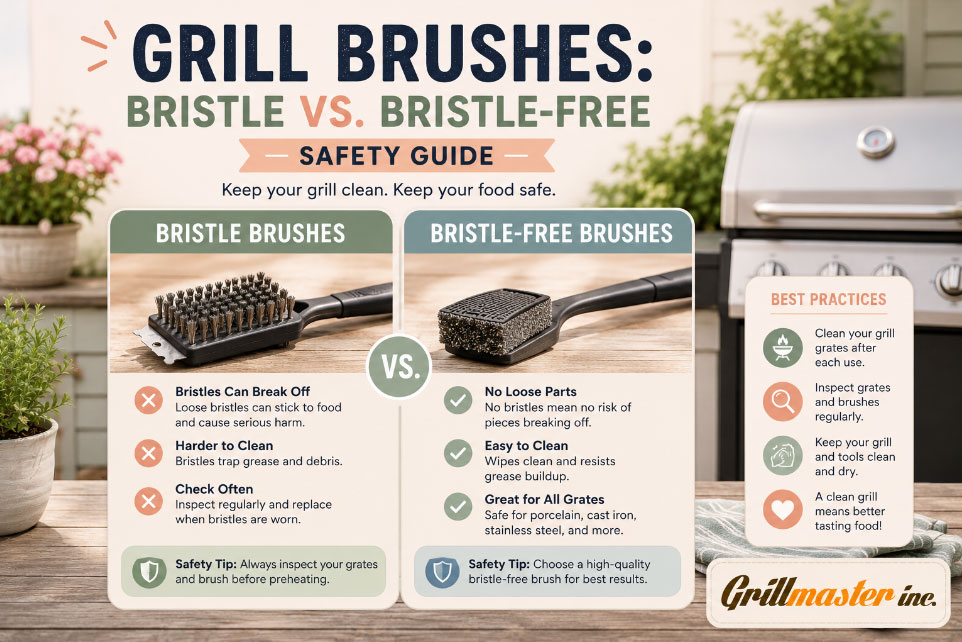
Grilling season sells a lot of things: propane, charcoal, marinades, tongs shaped like alligators. But the tool that quietly does the most damage in American kitchens and backyards every summer isn't the grill itself. It's the little wire brush hanging next to it.
That eleven-dollar brush has sent thousands of people to the emergency room, sparked a wave of federal recalls in 2026, and turned "clean your grill" into a phrase that emergency physicians now say with a wince. This guide breaks down exactly why wire bristle brushes carry risk, what the bristle-free alternatives actually offer, and how to pick a tool that gets your grates spotless without the trip to urgent care.
The Short Answer
Wire bristle grill brushes clean fast and cheap, but the metal bristles can snap off, hide in cooked food, and get swallowed — sometimes lodging in the throat, esophagus, or intestines and requiring surgery to remove. Bristle-free brushes (coil brushes, nylon brushes, palmyra-fiber brushes, scrapers, and steam cleaners) eliminate that specific hazard while still delivering solid cleaning power on most porcelain-coated, stainless, and ceramic grates. For cast iron or heavily caked grates, a wire brush used correctly and replaced often is still the strongest option, but medical and consumer-safety groups increasingly recommend switching to a bristle-free design for most households, especially those with young children.
A Kitchen Tool With a Surprisingly Bad Safety Record
Wire bristle brushes have been a grilling staple since backyard barbecues became a summer ritual, and for most of that history, nobody thought twice about them. That changed when doctors started noticing a strange, hard-to-diagnose pattern: patients coming in with unexplained throat pain, abdominal cramping, or signs of internal bleeding, with no obvious cause — until imaging revealed a thin piece of metal wire lodged somewhere it had no business being.
The Injury Numbers Behind the Warning Labels
The Centers for Disease Control and Prevention first flagged the problem publicly in 2012, after a hospital system in Providence, Rhode Island reported six people who had swallowed grill brush wire bristles over roughly a year and a half. That report triggered a wave of research, and the numbers that followed were not reassuring. A national epidemiological study using the Consumer Product Safety Commission's injury surveillance system estimated that 1,698 emergency department visits occurred nationwide between 2002 and 2014 due to wire-bristle grill brush injuries, with the typical patient around 30 years old and injuries split almost evenly between men and women.
The trend didn't fade with awareness campaigns — it got worse. A more recent analysis covering 2015 through 2023 found an estimated 3,739 injuries during that period, a 229 percent jump compared with the 2006-to-2014 window, with most patients treated and released but nearly a quarter requiring hospital admission. The researchers behind that study didn't mince words, noting that public warnings issued over a decade ago have not meaningfully reduced how often this happens.
That's the uncomfortable core of the bristle-versus-bristle-free debate: this isn't a rare fluke or an urban legend passed around at cookouts. It's a documented, measurable, and apparently persistent injury pattern tied to one specific design choice — loose metal wires scrubbing against hot metal grates.
How a Two-Dollar Piece of Wire Ends Up in Someone's Throat
The mechanics are almost absurdly simple. Wire bristle brushes are built from dozens of thin metal filaments, usually stainless steel or brass, bundled and welded or crimped into a head. Every time you scrub a hot grate, friction and heat stress those welds. Eventually, a bristle snaps off. It's small — often under half an inch — and it doesn't announce itself. It can catch on a grate, fall onto a burger, or embed itself in a piece of chicken without leaving a visible trace.
From there, it gets eaten. Most of the time, nothing happens; the body handles small foreign objects better than people assume. But when a bristle lodges in the tongue, tonsil, throat, esophagus, or further down in the stomach or intestine, it can puncture tissue. Surgeons have documented cases involving perforation of the small bowel, abscess formation, and emergency operations to retrieve a piece of wire smaller than a paperclip. One case report on a bowel perforation from a swallowed bristle noted plainly that despite CDC warnings issued back in 2012, these injuries keep happening and keep requiring emergency surgical intervention — which is precisely why some surgeons have publicly asked whether wire bristle brushes should be pulled from shelves altogether.
The scary part for consumers is the delay. Symptoms don't always show up immediately after the meal. People show up in emergency rooms hours or days later with vague throat pain, difficulty swallowing, or abdominal pain, and the wire bristle is often the last thing anyone suspects until imaging finds it.
2026's Recall Wake-Up Call
If this all still sounds theoretical, 2026 made it very concrete. In March, the CPSC announced the recall of more than 10 million Nexgrill metal wire bristle brushes, sold nationwide including at Home Depot, after the agency identified a design defect that lets metal bristles detach and be swallowed without detection, with Nexgrill logging at least 68 reports of bristles coming loose and five confirmed cases of consumers swallowing bristles and needing medical treatment.
Then in July, Conair recalled roughly 1.7 million Cuisinart-branded wire bristle grill brushes sold at retailers like Burlington, TJ Maxx, and Ross, plus Amazon and Cuisinart's own site. The recall covered eight different brush models sold between 2009 and 2026, after the company received at least 54 reports of bristles detaching, including three incidents where someone swallowed the metal pieces and needed medical help removing them.
Two major recalls in a single year, covering nearly 12 million individual units, from mainstream brands sold at mainstream stores — this isn't a fringe issue affecting some obscure off-brand product. It's baked into the basic design of the wire bristle brush category, which is exactly why the bristle-free market has grown so fast.
Meet the Bristle-Free Alternatives
"Bristle-free" isn't one product — it's a category of designs that all solve the same problem differently. Here's what's actually on the market.
Coil and Loop Brushes
Instead of dozens of individual wire filaments, coil brushes use continuous loops of twisted stainless steel wire, sometimes shaped like a spring or a series of interlocked rings. Because the wire is one continuous piece rather than short individual bristles, there's nothing short and rigid to snap off and hide in food. Coil brushes tend to clean nearly as aggressively as traditional bristle brushes, which makes them a popular middle-ground choice for people who don't want to give up scrubbing power.
Nylon Bristle Brushes
Nylon-bristle brushes swap metal for heat-resistant plastic bristles, often paired with a stainless steel scraper edge on the same head. They're gentler on porcelain-coated and ceramic grates, which wire brushes can scratch over time, exposing bare metal to rust. The tradeoff is that nylon brushes generally shouldn't be used on very high heat or directly over an open flame, since the bristles can melt — most are rated for a specific grate temperature, so checking the packaging matters.
Palmyra and Natural Fiber Brushes
Palmyra brushes use stiff plant fiber bristles, similar to what you'd find in an old-fashioned scrub brush. They're heat-resistant, don't scratch coated surfaces, and — like nylon — carry essentially zero ingestion risk since the fibers are too flexible and too large to behave like a wire bristle even if a piece did break free. They're a favorite among cast-iron grate owners who still want a natural-fiber feel.
Scrapers, Pumice Stones, and Grill Stones
The simplest bristle-free option skips bristles entirely. Flat metal scrapers, wooden scraper blocks, and pumice-based grill stones physically scrape carbon and residue off the grate rather than brushing it away. They require a bit more elbow grease and a slightly different technique, but there is nothing to shed, melt, or ingest — full stop.
Steam Cleaning Brushes
A newer entrant, steam brushes use a water reservoir and heat from the grill itself to generate steam that loosens baked-on grease and food, which is then wiped away with a bristle-free pad or brush head. They're praised for cutting through stubborn grime without scratching, though they typically cost more and take a few extra minutes per cleaning session.
Bristle vs. Bristle-Free: Side-by-Side Comparison
| Feature | Wire Bristle Brush | Bristle-Free Brush |
|---|---|---|
| Cleaning material | Loose stainless steel or brass wire bristles | Coiled wire, nylon, palmyra fiber, pumice, or steam + pad |
| Ingestion risk | Documented and significant — bristles can snap off and hide in food | Minimal to none — no short, rigid bristles to detach |
| Cleaning power (baked-on grease, cast iron) | Excellent | Good to very good, slightly less aggressive on heavy carbon buildup |
| Safe for porcelain/ceramic grates | Can scratch coating over time | Generally gentler, less scratching risk |
| Heat tolerance | Very high | High for coil and pumice; nylon has a lower heat ceiling |
| Typical lifespan | Often needs replacement every 6–12 weeks with regular use | 3–6 months for coil brushes; scrapers can last years |
| Price range | $8–$20 | $10–$25 |
| 2026 recall history | Two major recalls affecting roughly 12 million units | No comparable large-scale recalls |
| Best suited for | Occasional users willing to inspect and replace often | Households with kids, frequent grillers, safety-conscious buyers |
If You Still Want to Use a Wire Brush, Do This
Plenty of people will keep using wire bristle brushes anyway, because they're familiar, cheap, and effective on stubborn buildup. If that's you, a few habits meaningfully cut your risk.
Inspect the brush head before every single use, not just occasionally. Run a finger — carefully — or a paper towel over the bristle area and look for anything loose, bent, or missing. Replace the brush the moment you notice bristles falling out or the head looking frayed; most manufacturers and safety groups recommend swapping a wire brush out roughly every one to three months depending on how often you grill. Clean the grill before it's blazing hot rather than immediately after cooking on high heat, since extreme heat accelerates weld fatigue. After brushing, wipe the grate down with a damp cloth or a few sheets of paper towel and inspect for any stray wire before you start cooking food on it. And never buy a wire brush that already looks like the bargain-bin version of one — cheap manufacturing and weak welds are a big part of why bristles detach in the first place.
Warning Signs Your Brush Belongs in the Trash
Toss a wire bristle brush immediately if you notice any of the following: visibly missing or bent bristles, a head that looks "bald" in patches, rust forming around the bristle base, bristles that feel loose when you gently tug them, or a handle-to-head connection that wobbles. None of these are cosmetic issues — they're all early indicators that bristles are about to separate from the brush and end up somewhere you don't want them.
What to Do If You Think You Swallowed a Bristle
If you or someone at your table suddenly develops sharp throat pain, a feeling that something is "stuck," pain when swallowing, or unexplained abdominal pain after eating grilled food, take it seriously rather than assuming it will pass. Stop eating, don't try to force anything down to "push it through," and seek medical evaluation — an emergency room or urgent care center can use imaging or direct visualization to check for a foreign object. Because wire bristles are thin and often don't show up clearly on a standard X-ray, mention specifically that grilled food and a wire brush were involved, since that detail changes how physicians look for it.
For guidance that doesn't require an ER visit — questions about whether a swallowed item warrants concern, or general poisoning and ingestion guidance — the Poison Help line at 1-800-222-1222 connects you to a certified poison specialist 24 hours a day, free of charge, anywhere in the country.
Where to Report a Problem or Get Help
If a wire bristle brush injures you, or you notice a brush shedding bristles, reporting it helps regulators track patterns and issue recalls before more people get hurt.
U.S. Consumer Product Safety Commission (CPSC) 4330 East-West Highway, Bethesda, MD 20814 Consumer hotline: 1-800-638-2772 File a report directly at SaferProducts.gov. Note that the CPSC has announced it will relocate its headquarters to 441 G Street NW, Washington, DC 20548 by early October 2026, so mailed correspondence sent later in the year should go to the new address once the move is complete.
National Capital Poison Center (Poison Control) 3201 New Mexico Avenue NW, Suite 310, Washington, DC 20016 24/7 Poison Help line: 1-800-222-1222 Online guidance available at poison.org
Centers for Disease Control and Prevention (CDC) 1600 Clifton Road NE, Atlanta, GA 30329 Public health guidance and the original wire-bristle advisory available through cdc.gov
If your injury involved a recalled Cuisinart or Nexgrill product specifically, both companies are offering refunds — check the model number against the recall notice on CPSC.gov before continuing to use the brush.
Frequently Asked Questions
Are all wire bristle grill brushes dangerous? Not inherently, but the design itself carries a documented risk that bristle-free tools simply don't have. Quality, age, and how the brush is used all affect risk level, but no wire bristle brush is completely immune to shedding.
Are bristle-free brushes actually as good at cleaning? For porcelain-coated, stainless, and ceramic grates, yes — coil brushes and steam cleaners in particular come close to matching wire bristle performance. On heavily caked cast iron, a wire brush still has a slight edge, though a pumice stone or scraper used consistently closes most of that gap over time.
How often should I replace a grill brush? Most safety guidance suggests every one to three months for wire bristle brushes with regular use, and checking before every single use regardless of age. Bristle-free coil and nylon brushes can typically go longer, closer to three to six months, since there's no bristle-shedding failure point to watch for.
Can a swallowed bristle pass on its own? Sometimes, yes — many cases resolve without incident. But because bristles can perforate tissue on the way through, medical evaluation is the safer call if you suspect ingestion, rather than waiting to see what happens.
Were my grill brushes affected by the 2026 recalls? If you own a Cuisinart-branded wire bristle brush purchased since 2009, or a Nexgrill wire bristle brush with model numbers 530-0024, 530-0024G, 530-0034, 530-0039, 530-0041, or 530-0042, check the recall listings on CPSC.gov immediately and stop using the product if it matches.
The Verdict
Wire bristle brushes aren't a myth-driven scare — they're a tool with a real, well-documented, and apparently worsening injury pattern, backed by CDC advisories, peer-reviewed studies, and two major 2026 recalls covering nearly 12 million units. That doesn't mean everyone needs to panic-toss their brush tonight. It means the calculus has shifted: bristle-free tools have gotten good enough, affordable enough, and widely available enough that there's less reason than ever to accept the risk, especially in households with kids or anyone who grills often enough for a worn brush to sneak past inspection. If you love the scrub of a wire brush, treat it like a perishable item — check it constantly, replace it often, and never let convenience win out over a five-second glance at the bristle head before you fire up the grill.